What may a learned prior legitimately put in the null space?
Two scientific inverse problems on real survey cadences. In both, the thing a diffusion prior is asked to supply is exactly the thing the data cannot determine — so the usual worry about hallucination becomes a quantity you can compute rather than a caveat you write.
Headline numbers
starry, the field-standard forward modelNew to this? Two three-minute primers
Starspots 101
What a starspot is, and why a rotating spotted star produces a periodic light curve. Drag a spot around a live star, change the inclination, and watch the brightness respond — including the case where the spot sits on the cap that never rotates into view.
Aliasing & harmonics 101
Why two different periods can fit the same photometry exactly: folding at half the period when the star has two dips, and the one-cycle-per-day beat that ground-based observing bakes in. Includes what a periodogram is actually showing you.
The two problems
Starspot mapping
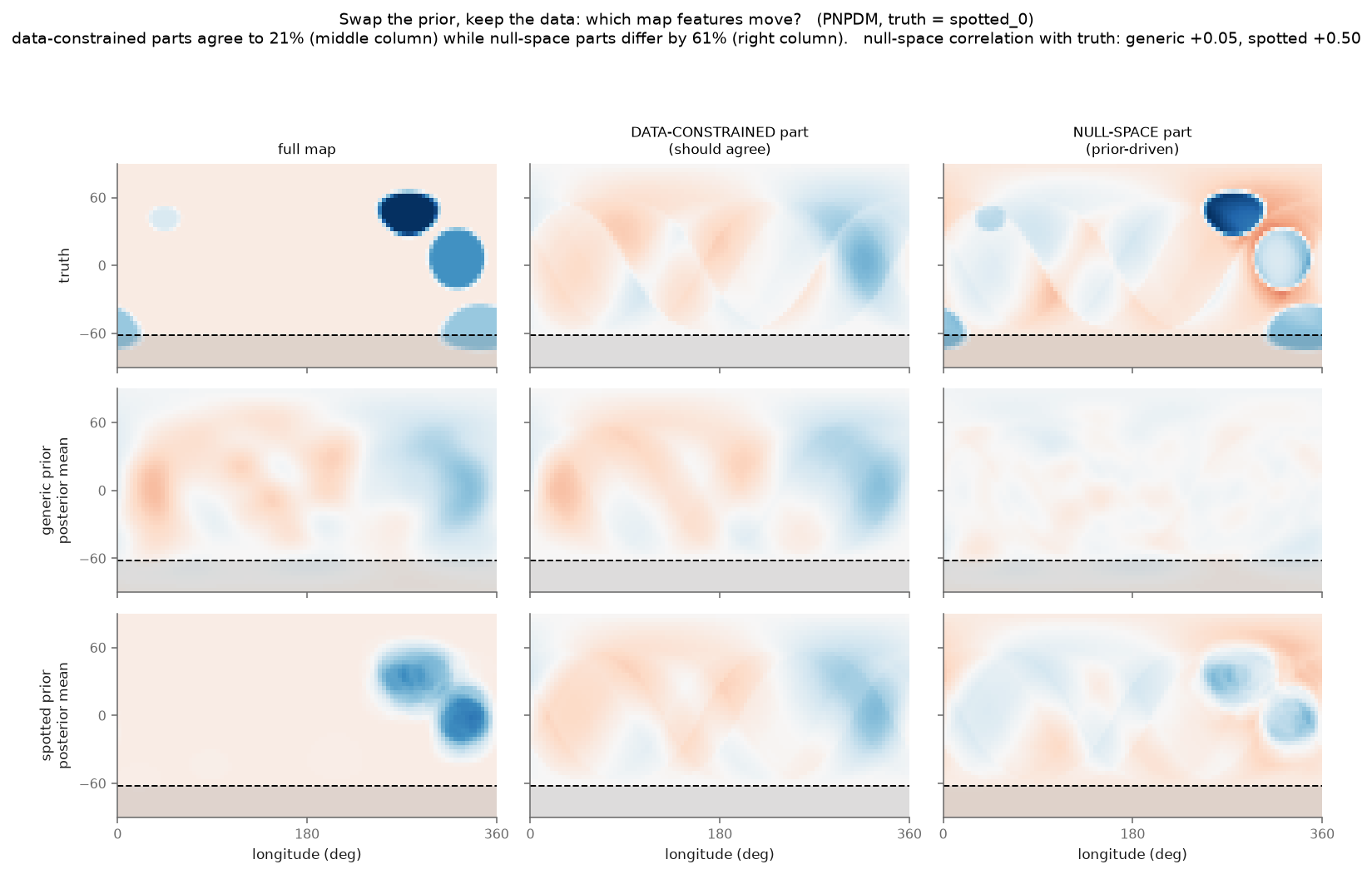
Recover a stellar surface map from a rotational light curve. The degeneracy is analytically known, so every posterior splits exactly into what the data determined and what only the prior could supply.
- effective rank (SNR>1)19
- null fraction99.59%
- spot map power that is invisible83.7%
- permanently hidden polar cap6.7%
Period recovery under a window function
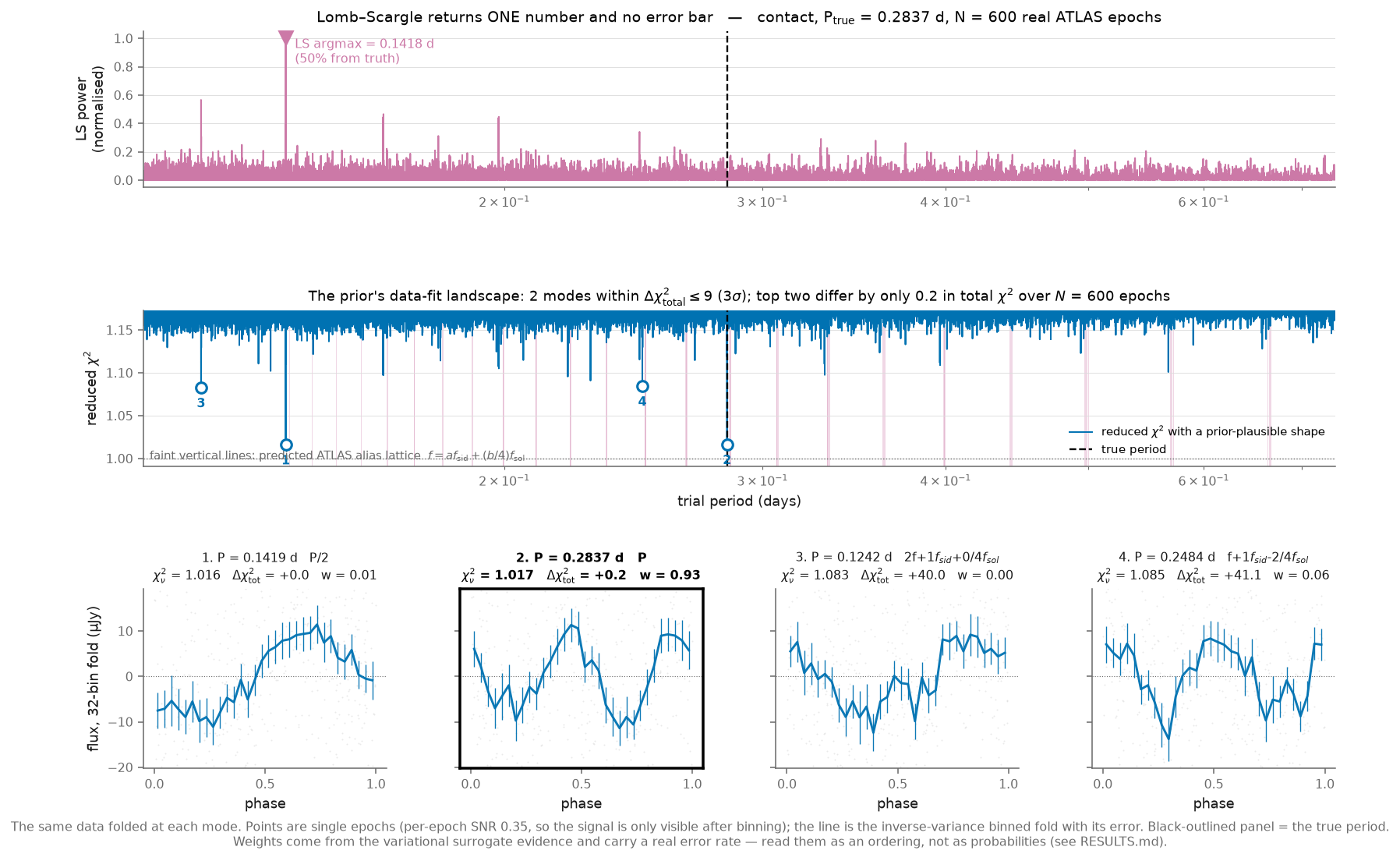
The alias family is a genuinely multimodal posterior, and its mode positions are
predicted in advance by the survey's own measured lattice
f = a·f_sid + (b/4)·f_sol.
- window peaks matching the lattice26
- median residual to lattice6.4×10⁻⁵ c/d
- contact binaries genuinely degenerate7 / 7
- detached EBs degenerate2 / 8
The result, in one table
Correlation between a posterior's null-space component and the true null-space component, on identical data (PnP-DM). Read across the rows.
| true surface | generic prior | spot-informed prior | verdict |
|---|---|---|---|
| spotted | +0.017 | +0.436 | legitimate — real hidden structure recovered |
| generic | −0.035 | +0.036 | inert — nothing recovered, no harm |
| out-of-distribution | −0.012 | −0.146 | hallucination — anti-correlated with truth |
Figures
Reproduce
conda env create -f environment.yml        # torch 2.11+cu128 (RTX 5070 = sm_120)

python scripts/nullspace_analysis.py       # what the data can and cannot constrain
python -m starspot.train --kind spotted    # ~25 min each on an RTX 5070
python -m starspot.train --kind generic
python scripts/prior_experiment.py         # the prior swap
python scripts/make_starspot_figures.py

./notebooks/render.sh                      # execute notebooks -> HTML + PDF
./scripts/build_site.sh                    # assemble this site under docs/
Both problems are registered in InverseBench's own interface — patches in
inversebench_patch/. The starspot problem runs against their
stock VPPrecond + SongUNet with no wrapper, and its
evaluator reports frac_null_power, rmse_constrained and
rmse_null so their harness can report how much of any reconstruction is
data-driven.
What this does not show
The surfaces and light-curve shapes are synthetic; the cadence and per-epoch uncertainties are real. No comparison against a published Doppler-imaging map has been made, so there is no external ground truth here. Nothing in this work resolves a spot map in the sense a reader might hope — that is the finding, not a shortfall of method. Every "fraction constrained" is a statement about a stated SNR threshold and a stated inner product (area-weighted L² on the sphere), both reported with the numbers.
Two claims were corrected during the work and the corrections are kept in the repository rather than quietly dropped: irregular sampling does not itself cost modes (diurnal clustering does), and the alias mask does not improve period recovery (the dominant failure is a harmonic, which no window mask can remove).