Emma Chickles

Emma Chickles

PhD Candidate, Department of Physics, MIT · Binary Star Astrophysics group, MIT Kavli Institute

I use GPUs and machine learning to search hundreds of millions of stellar light curves for ultracompact binaries — white dwarf pairs that orbit in minutes, and among the loudest guaranteed sources for LISA. Along the way I build the tests that catch a model learning the survey instead of the sky.


News


Research

Best Visualization · IAIFI 2026

When is a reconstruction a measurement, and when is it a hypothesis?

Two scientific inverse problems contributed to InverseBench (ICLR 2025), on real survey cadences.

Mapping a star's surface from its brightness alone, the data pin down 19 numbers out of 4,608 map pixels — so most of any published map is the prior, not the observation. Because the unmeasurable subspace is computable, “the model is inventing structure” stops being a caveat and becomes a measurement: a matched prior recovers genuinely hidden structure, while surfaces it has never seen come back anti-correlated with the truth.
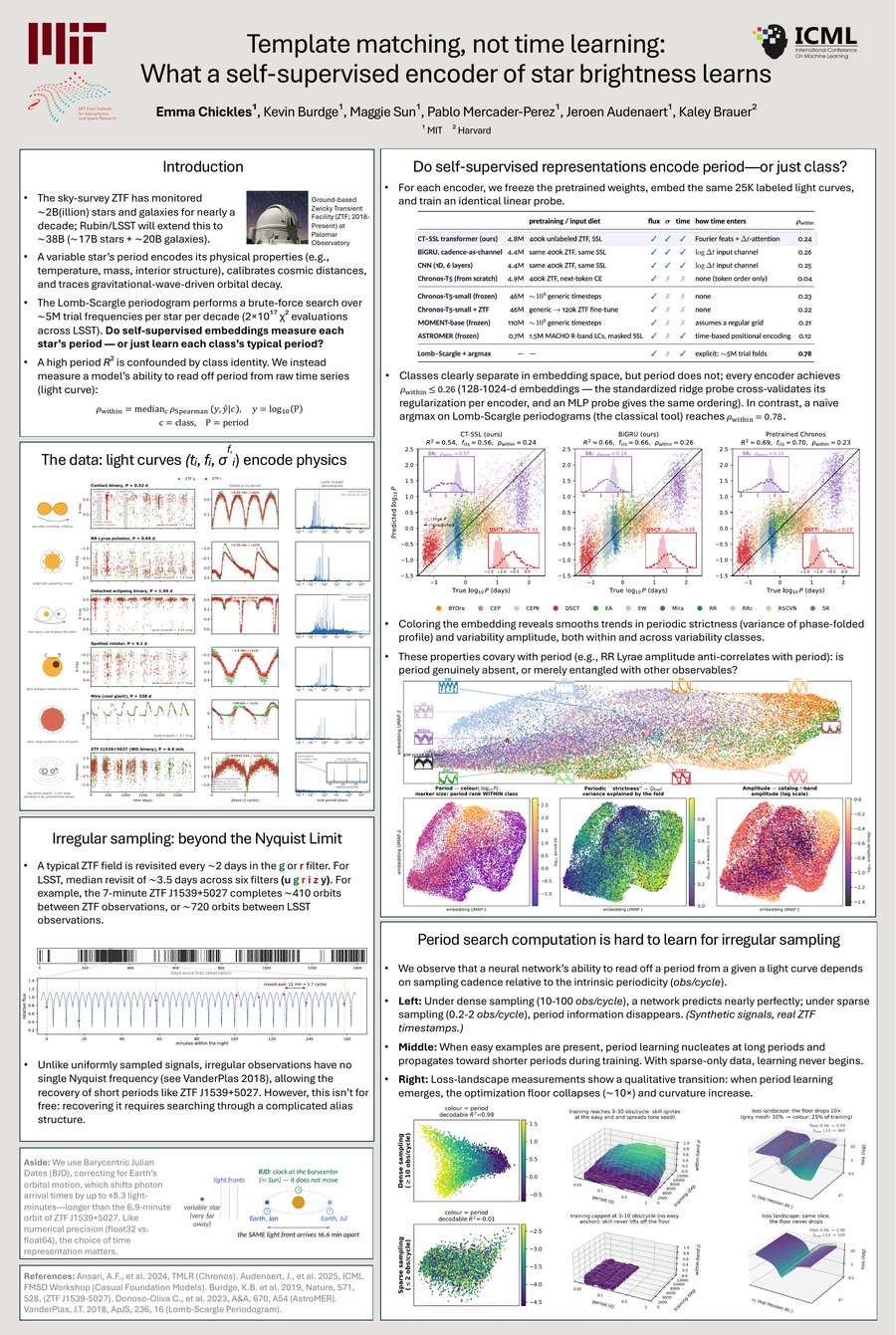
Conference poster: Template Matching, Not Time Learning, a diagnostic for self-supervised light-curve encoders.
ICML 2026 · AI4Physics workshop

Template matching, not time learning

A diagnostic for self-supervised light-curve encoders.

Self-supervised encoders appear to read a star's rotation period straight off its light curve. They mostly don't — they recognise the kind of star and recall the period typical of that kind. A drop-in diagnostic splits period-regression R² into between- versus within-class signal and exposes the difference across eight encoders, from a 4.4M-parameter BiGRU to the 110M-parameter MOMENT foundation model.

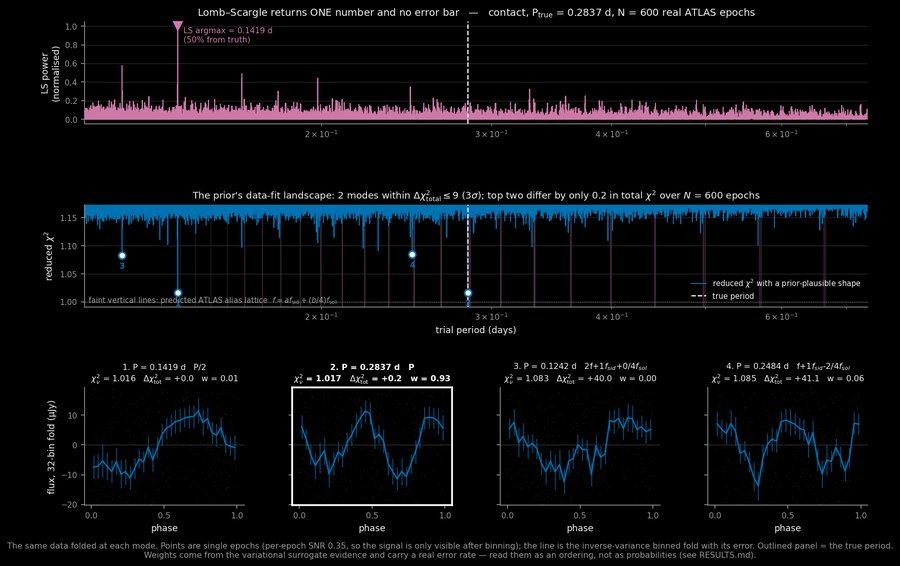
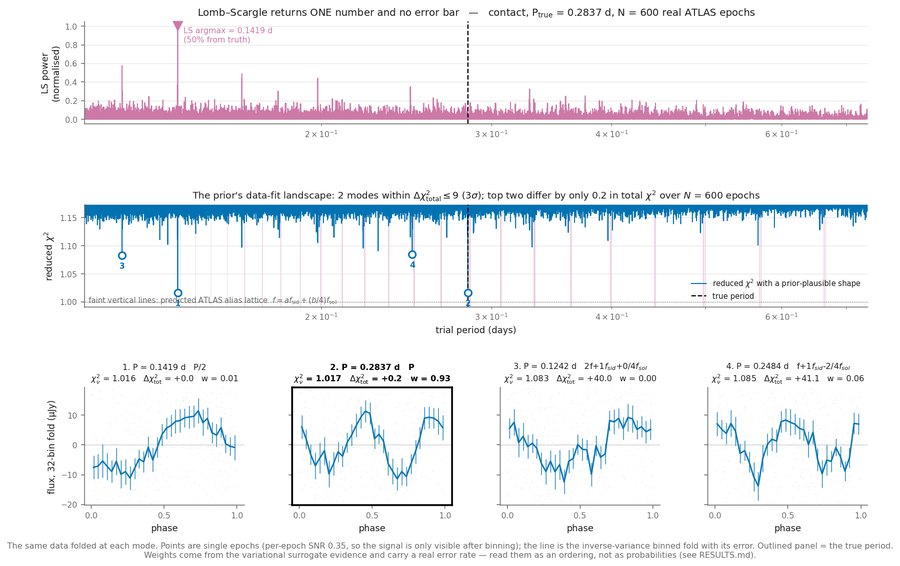
Periodogram and phase-folded light curves showing several candidate periods that fit the same data almost equally well.
Interactive

Explorers you can poke at

Dependency-free browser tools for inspecting what a model actually learned.

An embedding explorer coloured by class, period, amplitude and periodic strictness; a 26k-star map of survey data with ultracompact binaries injected into it; an interactive HR diagram; and playable periodograms where you can watch a period search pick the wrong answer.


Publications

An eclipsing 8.56-minute orbital period mass-transferring binary

Chickles, E., et al. — The Astrophysical Journal (2026)

A gravitational-wave–detectable Type Ia supernova progenitor

Chickles, E., et al. — The Astrophysical Journal (2025)

Full publication list →


About

These systems matter because they are the guaranteed part of the millihertz gravitational-wave sky: LISA will detect on the order of 104 of them in the Galaxy, but for most the frequency derivative will be unmeasurable, so electromagnetically characterised anchors are what tie the gravitational-wave observables to real physical parameters. Two of mine are published — an eclipsing 8.56-minute mass-transferring binary, and a Type Ia supernova progenitor detectable in gravitational waves.

Finding them means searching hundreds of millions of noisy, irregularly sampled brightness measurements: 11 TB pipelines, distributed GPU training, and a search that went from three months of compute to six hours across 16 GPUs.

A model that looks right and a model that is right produce the same demo, so a good part of my work is building the tests that tell them apart, and the visualizations that let someone check the reasoning rather than take my word for it.